

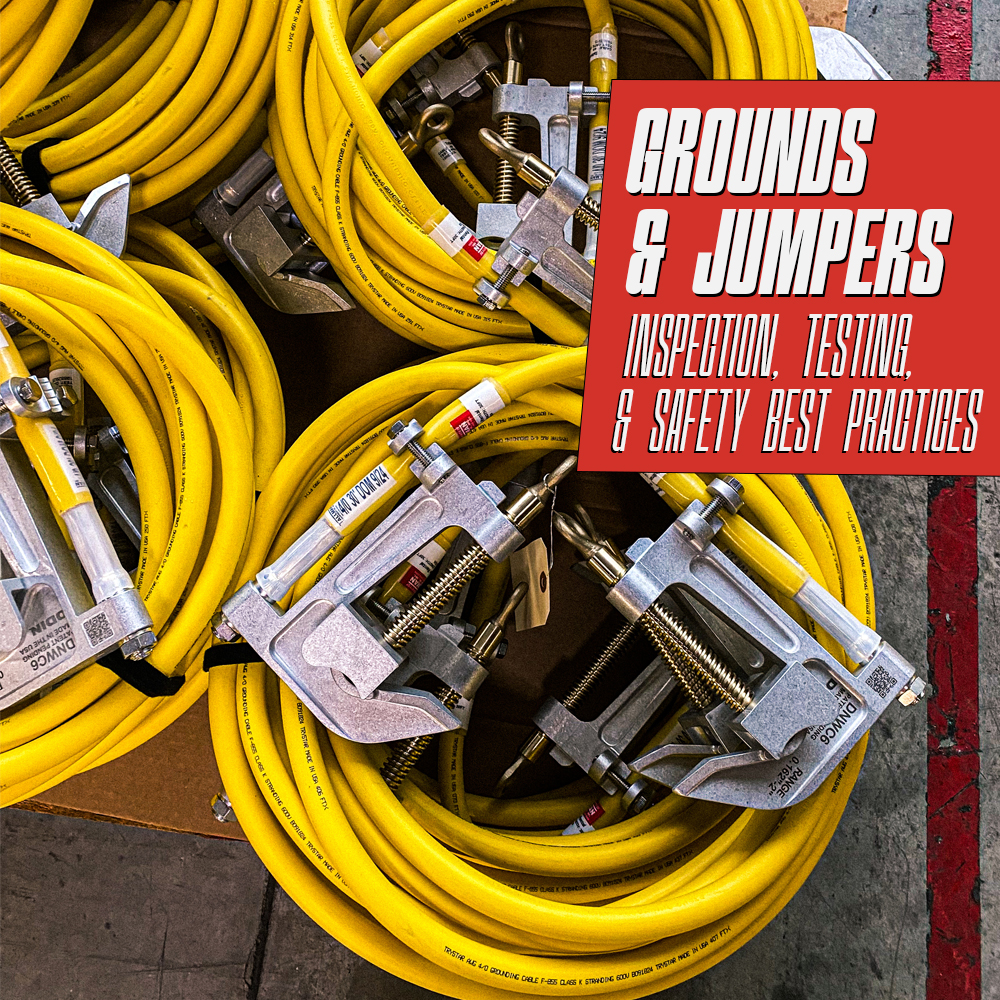
Temporary protective grounds and jumper sets from Tallman Equipment are built to the highest standards. The design and construction are meant to be durable enough to hold up to repeated use and a long service-life. But power linemen are well aware that the realities of the field put even the most well built equipment to the test.
Grounds and jumpers get tossed in truck beds. Dragged through mud. Left in the rain. Other tools thrown on top of them. Coiled and uncoiled hundreds of times. Over time, wear and tear quietly adds up, and when it comes to temporary jumper sets, that can mean the difference between keeping someone’s lights on or not, and for temporary protective grounds, assumptions can be fatal. If you rely on your grounds and jumpers to protect your life and keep the power flowing, then their care, inspection, and testing should never be an afterthought.
Take Your Personal Protective Grounding Personally
Protective Grounds
Grounding cables are a critical part of your personal protective grounding system. Before work begins on a de-energized line, grounds are installed to create a low-resistance path to earth.
If the circuit unexpectedly becomes energized, whether from human error, backfeed, induction, stored energy, or switching mistakes, properly rated grounds help carry that fault current safely to ground. Higher loads and increased fault current levels mean there’s less margin for error than ever before.
That’s why your grounding equipment must be properly built, properly rated, and properly maintained.
Temporary Mechanical Jumpers
Jumpers serve a different purpose. These insulated cable assemblies temporarily carry current to maintain circuit continuity during maintenance or construction work.
Unlike grounds, jumpers are designed for continuous current flow, and their insulation is there to protect the worker from hazardous voltage exposure.
Both are essential. Both are engineered for specific jobs. And both demand attention.
More Than “Cable With Clamps”
At first glance, a ground or jumper set seems simple: cable and clamps.
In reality, every component is engineered to perform under extreme conditions, particularly during a fault event where high current must be carried long enough to clear the circuit.
When selecting ground or jumper sets, every component matters.
Grounding Clamps
Available in multiple configurations, grounding clamps are often constructed from aluminum, bronze, or a combination of both. Each clamp carries a fault current rating: its ability to withstand high current for a specified duration without failure.
Jumper Clamps
Options include hand-applied floating head clamps and hot-stick applied designs. The application method should match your work practice and safety requirements.
Grounding Cable
Grounding cable is built to withstand maximum available fault current. Key variables include:
-
Conductor size
-
Strand count
-
Diameter
-
Voltage rating
Always verify that grounding cable meets or exceeds applicable ASTM standards.
Jumper Cable
Jumpers are rated by:
-
Ampacity (continuous current rating)
-
Insulation voltage class (15kV, 25kV, and 35kV)
Ferrules
The ferrule connects the cable to the clamp, and it’s often one of the first components to show wear. Poor crimps, corrosion, or stress fractures can compromise the entire assembly. Options include:
-
Shrouded or unshrouded
-
Threaded or plain
Small part. Big responsibility.
Elbows
Grounding elbows provide visible grounding for transformers, switchgear, and other equipment. Available in standard voltage classes to match your system.
Inspection: Before and After Every Use
If there’s one habit every crew should build, it’s this: Inspect grounds and jumpers immediately before and after use.
If something looks questionable, take it out of service.
During inspection, check for:
-
Broken or cut cable strands
-
Loose or deteriorated heat-shrink strain relief
-
Corrosion at cable-to-ferrule connections
-
Inadequate or incomplete crimps
-
Stress fractures in ferrules
-
Damaged clamp jaws, screws, saddles, or eye bolts
-
Missing manufacturer-supplied components
Clamps must be complete and fully functional. Strain relief must be intact. Connections must be solid.
These aren’t cosmetic issues. They’re safety issues.
Visual Inspection Isn’t Enough
A cable can look fine on the outside and still have internal damage.
That’s why electrical testing is essential.
Although there are currently no federally mandated test intervals for protective grounding equipment, annual testing is widely considered a best practice. Some operations test more frequently depending on usage, environmental conditions, and handling practices.
Professional testing typically includes:
-
Resistance testing (for grounds and jumpers)
-
Insulation testing (for jumpers)
-
Detailed mechanical inspection
Tested sets should be labeled with:
-
Company name
-
Test date
-
Unique serial number
Documentation matters, especially when safety is on the line.
Accessories That Support Safe Grounding
Beyond cable sets themselves, several accessories can improve efficiency and organization:
The right accessories help protect your investment and keep your equipment ready for use.
Don’t Take Them for Granted
Grounds and jumpers may not be flashy tools. They don’t get the attention of big equipment or new technology.
But when something goes wrong, they are the last line of defense between you and catastrophic energy.
Treat them that way.
Inspect them. Test them. Maintain them. Replace them when necessary. And buy from manufacturers who build to recognized industry standards and stand behind their work.
Because at the end of the day, protective grounding isn’t just equipment.
It’s personal.
For the best tools for linemen, trust Tallman
Tallman Equipment is a proud ASTM member. With more than 70 years of experience in the utility industry, we understand what linemen need to get the job done. Our tool experts are ready to help answer questions and provide top-level service.
From ground sets, jumper sets, tool sales, tool repair, rubber goods testing, or tool rental, we are a one stop shop for all your electrical utility work needs.





0 Comments