


Every connection a lineman makes carries risk. When something goes wrong, personal protective grounds are what stand between a close call and a serious injury. They create a controlled path for fault current, pulling dangerous energy away from the worker and safely into the ground.
But that protection only works if the connection holds. A loose clamp or poor contact point can compromise the entire system at the worst possible moment. That’s why choosing the right grounding clamp isn’t just a detail, it’s a critical safety decision.
In this guide, we’ll break down the most common types of grounding clamps used in the field, where they perform best, and what to look for when selecting equipment. And if you need help choosing the right grounding clamps or ground sets for your application, the team at Tallman Equipment can point you in the right direction.
Materials
Ground clamps are usually made from aluminum or bronze. Both materials conduct electricity well. Aluminum clamps are lighter and cost less, while bronze clamps are heavier but resist corrosion better. Because of this, bronze clamps are often used for longer-term jobs, and aluminum clamps are commonly used for temporary ground sets.
Options
C-Type Clamps

C-Type Grounding clamps are perhaps the most commonly used clamps. They are useful for direct connection to round conductor cable, to cluster bars, or temporary grounding rods. Some linemen prefer C-Type Clamps because they feel like they can be cranked down tighter for extra security.
Duckbill (Snap-On) Clamps

Duckbill Clamps are another popular option. They are especially useful for overhead applications. The design allows linemen to easily hook the “bill” over the conductor before tightening into place.
Flat Face/Tower Clamps

Rather than attaching to round surfaces like conductor cable, flat face grounding clamps are designed to create solid contact across a flat surface such as is often found on towers. Bronze is popular for tower clamps because they tend to stay installed for longer periods.
Ball and Socket Clamps (Ball Stud)
Ball Stud Clamps are specially designed to attach to dedicated ball stud grounding posts. The design allows the ground set to swivel and hang in a natural position with lower stress on the cable.
Penetrator Clamps
Penetrator clamps are used for URD or on other insulated conductor cable. The name comes from the penetrating screw or spike which pierces to the core of concentric neutral cable. This guarantees contact with the conductor and complete de-energization.
Jaw Types (Class)
The different styles of ground clamps often offer a choice between smooth jaws and serrated jaws. These grounding clamps are labeled as Class A (smooth jaw) or Class B (serrated jaw).
Smooth jaws are popular for clean and smooth surfaces because they ensure maximum contact for low electrical resistance.
Serrated jaws are often selected for use on older or dirty equipment. The teeth help push through any dirt or corrosion to make good contact with the conductor.
Application Styles (Type)
ASTM F855 is the manufacturing standard for grounding equipment. It categorizes grounding clamps according to “Type” or installation method for the clamp: Type I (Eye Screw), Type II (Stick Mounted), and Type III (T-Handle)
Type I clamps are identifiable by the Eye Screw closure. These are often used for overhead applications where they are put in place with a shotgun stick. They can also be tightened by hand (linemen will often use a screwdriver through the eyelet to crank these clamps tight).
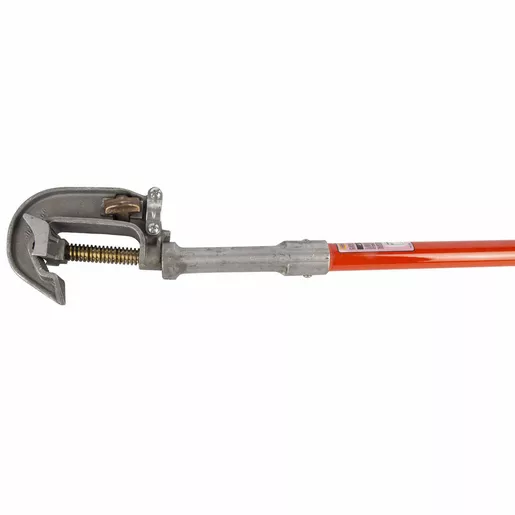
Type II clamps are exclusively installed via hot stock. The clamps are permanently mounted to the end of dedicated hot sticks. These clamps are intended for short term use only.

Type III clamps have a t-handle screw for installation by hand.
Grades
ASTM F855 has seven “grades” of grounding clamps. These grades group clamps by how strong they are and how much electricity they can safely carry. A higher grade means the clamp can handle more force and more electrical current.
Clamp grades are based on a few important ratings:
Continuous current (amps) is how much electricity a clamp can carry all the time without getting too hot or failing. Example: a Grade 5 clamp can carry 400 amps continuously.
Withstand rating (kiloamps) is how much fault current a clamp can handle for a short time. Example: a Grade 5 clamp can handle 45 kiloamps for 15 cycles (250 milliseconds) and 43 kiloamps for 30 cycles (500 milliseconds).
Ultimate rating (kiloamps) is the highest fault current a clamp can survive, even if it cannot be used again after. Example: a Grade 5 clamp can handle 59 kiloamps for 15 cycles, 42 kiloamps for 30 cycles, and 29 kiloamps for 60 cycles.
Clamp It Down
A clamp’s rating only matters if it makes a strong, tight connection. Even a high-grade clamp will not work well if it is installed poorly. A bad connection increases resistance, which lowers performance and reduces protection.
Picking the right clamp for the job helps make sure it is installed correctly. Choose the right clamp, install it the right way, and it will work well for you.
Always check with your foreman or engineer to be sure you are using the correct clamp for the job.
Trust Tallman
Tallman Equipment is a proud ASTM member. With more than 70 years of experience in the utility industry, we understand what linemen need to get the job done. Our tool experts are ready to answer your questions and take pride in doing the right thing for our customers. We provide linemen with the best tools and equipment, including ground sets and jumpers, to get the job done.
From ground sets, jumper sets, tool sales, tool repair, rubber goods testing, or tool rental, make Tallman your first and last stop for all your electrical utility work needs.


0 Comments